



Showing 20 search results of 5,118 videos found for


Forum for the Future utilizes the systems thinking 'iceberg model' to explore the civil rights movement, revealing how different parts of a system interact and influence one another.
This analysis clarifies that no single event initiated the movement; instead, it evolved through decades of collaboration and perseverance.
By understanding these dynamics, we can collectively reshape power and privilege, designing free, democratic societies that support everyone on the planet to flourish.

This webinar, originally held on April 29, 2020, explores whether sustainable protein can create a future-fit food system, as reviewed in our Future of Food report. It also examines how the pandemic is straining the current system and what the food industry can do to shape better long-term outcomes.
This recording is valuable for food industry professionals, particularly those in sustainability, nutrition, sourcing, innovation, or strategy. Watch to leverage Forum's futures and system change expertise in navigating today's rapidly evolving context.

The "Future of Sustainability 2020" webinar, held on July 8, 2020, explored how the radical disruption of the COVID-19 crisis can drive a truly sustainable, just, and resilient future.
Forum for the Future believes reverting to "business-as-usual" would be tragic. This moment offers an unprecedented opportunity to reinvent the future, and they call on business, governments, civil society, and communities to seize it for a more just, sustainable, and resilient world.
The discussion featured Dr. Sally Uren, CEO of Forum for the Future, co-host Hannah Pathak, and other leading experts from organizations including Laudes Foundation, Innovate UK, Bettys and Taylors, and Unilever.

The "Future of Sustainability 2020" webinar, held on July 22, 2020, explored whether COVID-19 accelerated or challenged the transition to a sustainable future. The crisis, devastating lives and economies—particularly informal ones—also presented a historic opportunity to reimagine how we rebuild.
Forum for the Future urged businesses, governments, and communities to create a more just, sustainable, and resilient world. Drawing on annual research, they highlighted the "Transform" trajectory as the sole path to achieve these systems. This approach recognizes interdependent challenges, aiming to shift political, economic, and social systems for human and planetary health, justice, and economic resilience. Now is the time for this transformative change.

Mr. Ankit Bhateja highlighted the critical role of cost-effective satellites and their data. He explained how this data enables real-time monitoring and 18-20 hour predictions, assisting farmers with drought warnings, enhancing naval navigation, and improving overseas logistics. This significantly reduces the economic and human toll of climate change.
As founder of Xovian, an aerospace startup, Mr. Bhateja develops a patented Passive RADAR Nano Satellite Constellation for 24/7 real-time earth surface monitoring, providing critical GIS data and predictions on oceans, extreme weather, and glaciers. He also inspires youth towards a technologically advanced India. We welcomed him to the third TEDxIIMSirmaur event, independently organized. Learn more at https://www.ted.com/tedx.

Oceana champions science-based policies, having protected nearly 4 million square miles of ocean. We fight to safeguard our oceans worldwide.
Join Oceana to support our work: https://bit.ly/39rh4sf. Subscribe to our channel and become a Wavemaker! 🌊

Dame Ellen MacArthur urges "bold and urgent action" to address plastic pollution. A 2020 study, "Breaking the Plastic Wave," by The Pew Charitable Trusts and SYSTEMIQ, reveals a grim forecast: without intervention, by 2040, plastic on the market will double, annual ocean entry will almost triple, and ocean stocks will quadruple. This echoes the Ellen MacArthur Foundation's 2016 warning of more plastic than fish by 2050.
The study confirms a circular economy for plastic is the only way to tackle waste at its source. This vision already unites over 850 organizations. Find out more here.

In July 2020, The Pew Charitable Trusts and SYSTEMIQ, with partners including the Ellen MacArthur Foundation, released "Breaking the Plastic Wave." This robust study on ocean plastic pollution revealed that without action, plastic volume will double, ocean entry will almost triple, and ocean stocks will quadruple by 2040. This aligns with the Ellen MacArthur Foundation's 2016 warning of more plastic than fish in the ocean by 2050.
The study emphasizes that a circular economy for plastic is the sole solution to tackle waste and pollution at its source. This vision already unites over 850 organizations through the New Plastics Economy Global Commitment and Plastics Pact network. Learn more about the study here.

Dame Ellen MacArthur emphasizes the need for bold, urgent action against plastic pollution. A comprehensive 2020 study, "Breaking the Plastic Wave," by The Pew Charitable Trusts and SYSTEMIQ, with partners including the Ellen MacArthur Foundation, reveals a stark future: without intervention, ocean plastic entering the environment will nearly triple by 2040, and total ocean stocks will quadruple. This aligns with earlier warnings that plastic could outweigh fish in the ocean by 2050.
The study confirms that a circular economy for plastic is the only effective solution, a vision already embraced by over 850 organizations globally. Discover more about this critical research and its pathways to stopping ocean plastic pollution here.

The new CCR episode, dropping Sat. July 25th, features a global "patchwork quilt" of five segments. Listen here: https://ccl.podbean.com/e/ccr-50-big-climate-problems-require-bigger-global-solutions/
Olivia Oguadinma (Nigeria) shares storytelling's power to motivate youth via her "Gems on Earth" podcast. Doerte Wihan (Germany) recounts her transformation to an Extinction Rebellion activist after a climate strike. Shane Petzer (South Africa) and his Magpie Art Collective turn trash into art, including chandeliers and #QuakerPeaceDoves, with remote participation.
The USA segment features former MA legislator Solomon Goldstein-Rose on climate efforts and "The 100% Solution" book. Visual artist Violet Kitchen discusses art's vital role in change movements.

Consumer sentiment had shifted away from disposable packaging, especially single-use plastics, until COVID-19 prompted a resurgence. Many assume single-use items are safer due to virus survival on surfaces, but this isn't necessarily true.
For Plastic-Free July, we'll examine a circular model offering a hygienic alternative to single-use. Join 3BL Media, Loop's Anthony Rossi, and UPS's Patrick Browne on July 22 at 2 p.m. ET. We'll discuss Loop's "21st-century milkman" approach during COVID-19 and how circular systems can prevent a backslide on plastic waste.

Endangered Blanding's turtle hatchlings begin their journey into the wild. These turtles can live 80 years, but their population is critically threatened by predation, disease, habitat destruction, and human collection.
In 2011, a Center petition secured CITES protection for Blanding's turtles. The Center, joined by renowned scientists like E.O. Wilson, further petitioned in 2012 for U.S. Endangered Species Act protection for the turtle and 52 other threatened amphibians and reptiles.
While not yet federally protected in the U.S., Blanding's turtles are safeguarded by state laws in several states.
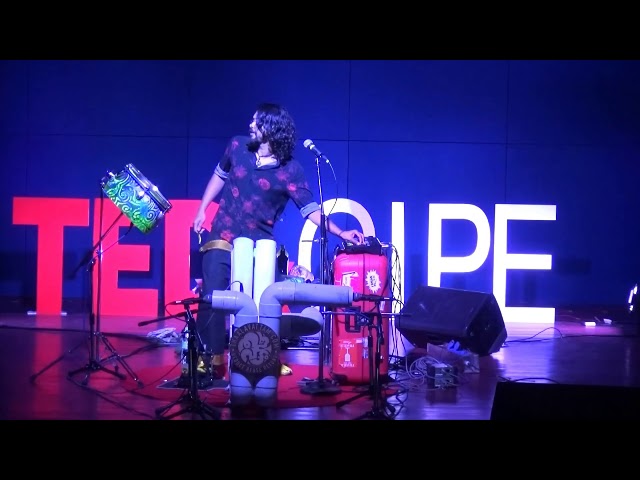
Thaalavattam is a collaborative music project founded by environmentalist and musician Montry Manuel. Based in Austria, Montry crafts unique instruments from discarded materials like industrial waste, paint cans, and bicycle parts. Its motto, "Reduce Reuse Retune," embodies the vision to "CLEAN THE ENVIRONMENT THROUGH MUSIC," drawing inspiration from nature, everyday life, and found objects.
Montry, a former art director and founding member of the Indian band Swarathma, launched Thaalavattam ("A Circle of Rhythm") in 2011, creating music from found objects. Thaalavattam gained international recognition as the first live act from India at Hungary's O.Z.O.R.A. Music Festival (2014-2016). They have since performed at TEDx Vienna and numerous European festivals, blending innovative sound with environmental advocacy. Learn more about TEDx events here.

In her talk, environmental activist Sumaira Abdulali recounts how resilience guided her through challenges in both life and advocacy. She has dedicated her life to fighting injustice, pioneering policy changes against issues like sand mining and noise pollution.
As the founder of 'Awaaz Foundation' and Convenor of MITRA, Abdulali actively raises global awareness about harmful environmental practices and promotes wildlife conservation. Her work, featured in numerous documentaries and press coverages, reaches thousands.
This inspiring talk was delivered at an independently organized TEDx event. Learn more about TEDx here.

North Atlantic right whales are critically endangered, with only about 400 individuals remaining. Fatal ship strikes and fishing gear entanglements are primary threats, causing deaths to outnumber births. Oceana Canada advocates for mandatory speed limits in key passages like the Cabot Strait to prevent further fatalities.
Oceana's Ship Speed Watch is an innovative tool that monitors ship speeds and positions in whale habitats along the East Coast. Utilizing AIS data, it displays restriction zones, emphasizing how enforced speed limits can prevent deadly collisions—a leading cause of whale injury and death.
Access Oceana Canada's full report: oceana.ca/RightWhaletoSave. Learn more about Oceana's binational campaign: www.oceana.org/RightWhaletoSave.

Rick Rybeck of Just Economics delivered a brief presentation to the Center for State Innovation, addressing the concepts of smart and dumb growth.
He highlighted "value capture" as a key technique. This method aims to fund infrastructure and create jobs, while simultaneously making housing more affordable and promoting sustainable development.
For further reading, see ShelterForce.

Sarah, an ELHS senior and future URI Ocean Engineering major, explores the often-overlooked human impact of plastic pollution. She begins with a brief history of plastic production, then highlights the pervasive issue of microplastics, exemplified by the Great Pacific Garbage Patch.
Her main focus is on how plastic pollution directly affects human health. She concludes by offering actionable solutions to combat plastic waste and promote ocean conservation. This talk was presented at an independently organized TEDx event. Learn more at https://www.ted.com/tedx.

Danat Tekie's TEDxUiO talk, "Demystifying 'sustainability'," explores youth as a driving force for a sustainable future and encourages self-reflection. It's a must-watch for anyone seeking clarity on sustainability.
Danat, an "earthpreneur" passionate about making sustainability business as usual, is Chief External Relations for Young Sustainable Impact (YSI). YSI solves global sustainability challenges by fostering youth entrepreneurship and innovation, creating impact startups. She previously helped build Future Leaders Global, a leading youth leadership program in the Nordics.
This talk was presented at an independently organized TEDx event. Learn more at ted.com/tedx.
Environmental Scientist and Advocate
What EarthSayers stands for
Discover Diverse Voices on EarthSayers
Unlike algorithm-driven platforms that push you into a content bubble, we ensure you hear a variety of perspectives from scientists, activists, Indigenous leaders, business innovators, and everyday citizens working toward sustainability.
EarthSayers CINEMA
Watch, learn and lead—sustainability starts with you.
The Thinking Game | Full documentary | Tribeca Film Festival official selection
“The Thinking Game” is the inside story of DeepMind's groundbreaking AI research, culminating in the Nobel Prize-winning AlphaFold breakthrough. Filmed over five years by the award-winning team behind "AlphaGo," this documentary explores co-founder Demis Hassabis's lifelong pursuit of artificial general intelligence and the rigorous scientific journey from mastering strategy games to solving the 50-year-old protein folding problem.
Following its world premiere at the Tribeca Festival, "The Thinking Game" is now available to watch for free. For those interested in hosting a screening for a classroom, community, or workplace, visit: rocofilms.com/films/the-thinking-game/.


